Author: Rachel Juma
There is a moment in many data-for-evidence projects when a number becomes a lived reality. It is the moment a spreadsheet becomes a face-to-face conversation with a community member in Tinderet, explaining why their water tastes different from their neighbour’s in Aldai. It is the moment a “60% positive perception score on water-point accessibility” becomes a mother describing the walk to the nearest borehole. That moment, where data meets lived experience, is where data governance is tested: it either accounts for the gap between the number and the experience, or it does not.
Data becomes governance only when it completes a loop back to the people it describes. In Nandi, that loop broke at several points, not because the data was inaccurate, but because no single person owned the handoff at each step: who validates a finding with citizens, who carries it into/within government, and who tracks the resulting commitment through to a decision. The three sections below, on relationships, inclusion and follow-through, document that breakdown.

Over the course of a multi-day engagement in the second half of July 2026, Nandi County, the Nandi County Youth Bunge Association (NCYBA) and Open Institute walked through all three phases of that journey: disseminating assessment findings for a citizen score-card on the state of water, health and education projects in Nandi County to county officials, validating that data directly with communities, and carrying it through the machinery of county government. What emerged was a working case study in what each phase actually requires: a validation exercise that surfaces gaps rather than smoothing them over, an inclusion process measured by who shows up and who is missing, and a follow-through pathway with a named contact and a decision point on the calendar.
Data governance is a relationship, not a repository
It is tempting to think of data governance as an infrastructure problem: build the dashboard, populate the database, publish the report. Nandi’s experience suggests that the most important governance decisions are not about where data is situated, but about who has the opportunity to engage with it.
Validating the health, water and education assessment findings directly with community representatives surfaced two things the original survey data alone could not. First, it exposed a limitation in the validation process itself: turnout from community-based organisations and ward-level members varied across subcounties (11 out of the 40 expected participants did not make it), and participants raised this unevenness as a shortcoming of the exercise rather than a detail to smooth over. Addressing this in future rounds would mean setting a minimum representation threshold per subcounty in advance, rather than treating overall attendance as sufficient, and confirming attendance directly with ward-level contacts rather than relying on word-of-mouth mobilization. This is recommended elsewhere in this piece for departmental turnout.
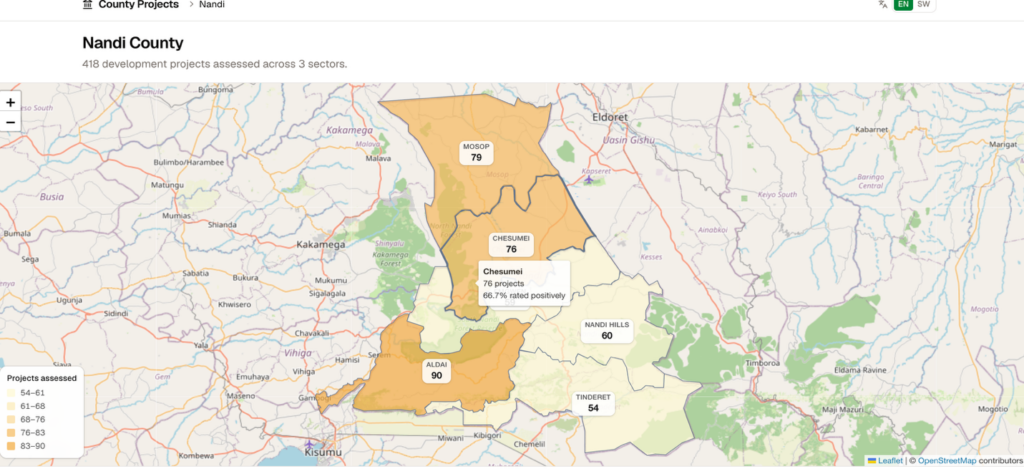
Second, it surfaced a specific question no dataset had captured and the team could not yet answer: why Aldai Subcounty’s water perception score was markedly more negative than neighboring subcounties. It also means being transparent about gaps still to be addressed. The team found that many water schemes operate without formal payment structures to Kapsabet Nandi Water and Sanitation Company (KANAWASCO), and that persons living with disabilities are not yet consistently factored into water project design. Surfacing this kind of information is necessary if any resulting policy is going to hold up once it meets reality.
Active citizenship shows up as inclusion, not just participation
When inviting citizens to an engagement, attendance is a necessary but insufficient condition for inclusion. Nandi’s engagement aimed for substantive inclusion rather than mere attendance. One recommendation raised by a community participant was the addition of a disability-status field to the registration form. While administratively minor, this omission has methodological consequences: without such a field, disability status is never recorded, and the county has no means of assessing whether persons with disabilities were represented, nor of tracking that representation over time.

Inclusion was uneven in practice, both geographically and by gender. Women constituted only approximately 41% of attendees across the community engagements. This underrepresentation is notable given the documented relationship between gender and water governance: in Kenya specifically, a case study of community water management in the Western Kenya highlands found that women bear primary responsibility for water provision and management at the household and community level, yet remain largely absent from the formal governance structures that make decisions about it. This pattern is not unique to Kenya. Globally, women and girls constitute an estimated 70% of those responsible for water collection in households lacking on-premises access, according to World Bank data on the gendered burden of water collection, and mixed-methods research across four countries, including Kenya, has documented the physical, temporal and safety burdens this responsibility imposes. Against this literature, a 41% female attendance rate at an engagement specifically concerned with water governance represents underrepresentation of the group most directly affected by its outcomes, rather than a marginal demographic imbalance. Turnout across subcounties was similarly uneven, with Mosop having the lowest number of participants.
Active citizenship also manifested in a less favorable form: citizen complaints. Such complaints constitute a specific empirical signal, especially when the underlying claim can be verified rather than merely repeated. Information of this kind becomes available only when citizens are positioned as active participants in monitoring service delivery, rather than as passive recipients of ex post reporting. A community capable of distinguishing “the water supply itself is adequate” from “no accountable structure exists for managing the scheme” is performing precisely the diagnostic function active citizenship is intended to serve.
Responsive government is a pathway, not a promise
Nandi’s team did not stop at handing over a report and a policy brief. It traced a pathway: meeting the Deputy Clerk’s office to time the request against the supplementary budget calendar, and agreeing on which sectoral committees would receive the policy.
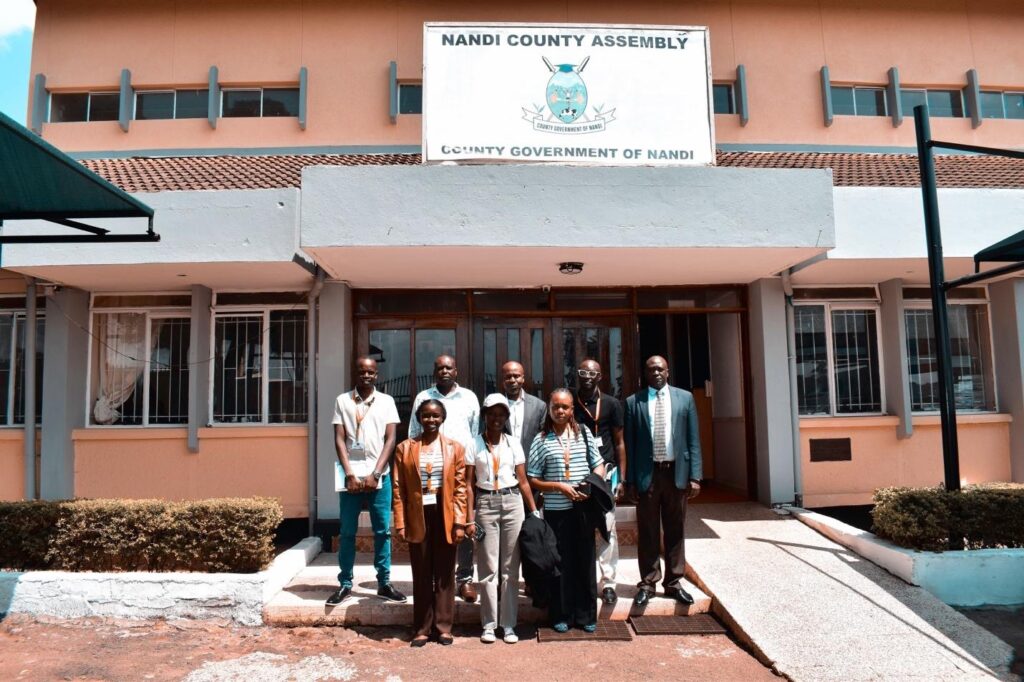
This pathway warrants a clarification of institutional role. Kenya’s devolved government structure separates the county executive, which implements policy and delivers services, from the county assembly, which legislates, approves budgets, and exercises oversight of the executive. Because implementation authority sits with the executive, responsiveness to the specific findings raised in this engagement, such as the payment-structure gaps identified with KANAWASCO or the disability-inclusion gaps in project design, ultimately requires executive action, not assembly action alone.
The assembly’s role in this pathway is nonetheless substantive rather than incidental. Its oversight function, exercised on behalf of the electorate, provides a mechanism by which citizen-validated findings can be converted into pressure on the executive to act. Routing the policy through the assembly’s sectoral committees is not a substitute for executive implementation; it is a channel through which elected representatives, informed by the same evidence citizens helped validate, can hold the executive to account for delivering on it. This is precisely the function that separation of powers is designed to serve: the assembly does not deliver water infrastructure or health services, but it can require the executive to explain why it has not, and can withhold approval of budgets and plans until it does. The Deputy Clerk’s office was identified as the point of contact for tracking the policy’s progress through this oversight channel, not as the body responsible for implementing it.
That pathway matters because responsive government is rarely a single decision. It is a sequence of small, trackable commitments distributed across both institutions. Each commitment functions as a discrete test of institutional responsiveness, and each depends on consistent follow-up rather than passive record-keeping.
The proposed equity-based allocation formula is itself a step towards executive responsiveness. It would weight water, health and education resources by population and by accessibility, instead of splitting budgets equally across subcounties. Because budget allocation formulas of this kind require assembly approval, the formula’s prospects depend on how much the assembly, exercising its oversight and budgetary function, is willing to press the executive for a more nuanced formula. If it advances through the supplementary budget process this coming cycle, it will be a meaningful indicator of whether the checks-and-balances pathway translates citizen validation into lasting responsiveness.
Why responsiveness stalls: understanding the engagement gap
The Nandi mission also surfaced a less visible but analytically useful pattern: turnout and follow-through from government stakeholders varied across the three days of engagement, for reasons worth examining independently of the substantive findings themselves. A departmental meeting convened to bring together twenty-four sector leads, eight from each of three sectors, was attended by two representatives from the water department, with the remaining departments not represented on that occasion. Statisticians were not among those present, even though the visit was intended to walk departments through statistical findings meant to inform their own budgetary processes. A subsequent attempt to engage the county’s health lead did not come to fruition.
This pattern is better understood as a coordination challenge than as institutional resistance. The explanations offered afterward were largely procedural rather than substantive. Departments do not always have full visibility into the technical purpose of an exercise of this kind, which may affect how attendance is prioritised. Meetings are sometimes confirmed through informal channels rather than formal scheduling processes (though this was not the case for this particular activity), creating conditions under which a scheduling gap can arise even when all parties believe the arrangement is settled.
In the absence of a designated internal owner responsible for coordinating departmental participation, the burden of follow-up defaults to the civil society partner, a dynamic consistent with what public administration scholars call the problem of many hands: when responsibility for an outcome is distributed across many actors, no single one of them can reliably be held to account for the follow-through, and the gap tends to fall to whoever is left holding it. Communities report an analogous pattern from their own vantage point: recommendations from prior engagements are frequently discussed without a clear account of subsequent action, which over time reduces expectations regarding the likelihood of follow-through.
The combination of the absence of a single internal owner for follow-through, and a pattern of tempered expectations among communities, is an equally important target for a data governance strategy as any dashboard or database. This is consistent with research on collaborative governance, which finds that successful collaboration between government and external stakeholders is rarely resolved in a single encounter; it develops through repeated, iterative cycles of small, visible wins that gradually build trust and shared commitment.
What ties it together
Measured against its own targets, the mission’s results were mixed. Community turnout fell 11 short of its target of 40 representatives, and representation by the county executive was also wanting. Despite this, the engagement produced a substantive set of recommendations actioned to a policy brief, including GIS mapping of county projects that could potentially influence the supplementary budgeting process.
More importantly, this demonstrates that beyond dashboards, we must always strive to keep data close to the people it describes, and keep citizens even closer to the institutions that act on it. Data becomes governance only when it completes a loop back to the people it describes.